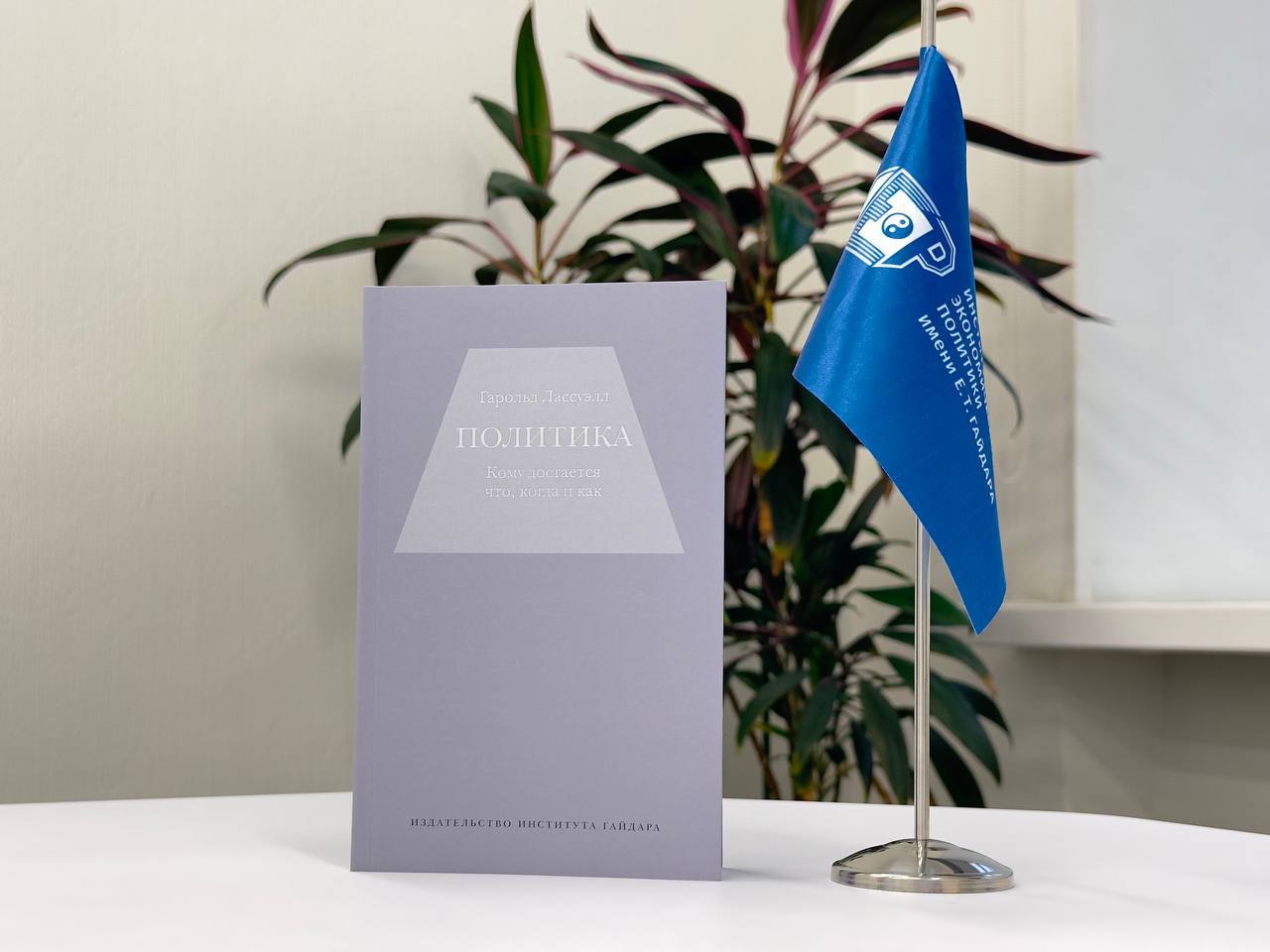
Mark Belov, Bachelor of Law from the National Research University Higher School of Economics, Master of Philosophy from the European University in St. Petersburg, specialist in political theory and law, and independent researcher, has prepared a review of Harold Lasswell's book Politics: Who Gets What, When, How, published by the Gaidar Institute Press in 2026..
Lasswell is one of the founders of political science as we know it today, a man who changed the paradigm that existed in political science from a normative bias to a descriptive one, describing politics as it is and “strictly scientifically.” After reading it, I would say that his approach is a kind of scientific version of realpolitik. A science free from values, but nevertheless serving the goals of democracy. In this regard, it is interesting to compare this (still normative?) approach with the method of Panagiotis Kondylis.
According to Lasswell, the study of politics is based on the study of influence and those who wield it, as well as the means of exerting such influence. Hence the title of the book, as well as its basic structure. Influence is wielded by the main actors in politics – the elites; they achieve and exercise influence through competence, the management of symbols (propaganda), and violence – the masses are the object of all these instruments; the distribution of benefits takes place within the elite. Lasswell does not give any assessments and presents all these processes in a detached, objective manner. Perhaps political violence or propaganda are bad, but that is how politics is done, and there is nothing we can do about it.
Translating a book from 1936 with a similar understanding of politics in 2026, when various normative theories of democracy prevail, which necessarily include the masses or population groups in the political process, may seem strange. It seems to me that the publication of the translation is, of course, somewhat reflective of the times: when the mass movements that returned in the 2010s lost and faded into the background, and it seems that power everywhere, even in the remnants of democratic states, is in the hands of a certain circle of people, that is, the elites. Therefore, the translation of this classic work not only fills an academic gap, but also invites the general reader to reflect on the redefinition of the present moment through, seemingly, categories of the past.
Alexander Pavlov writes about the unexpected relevance of the book in the introduction, while leaving room for interpretation: to which state exactly should the proposed framework be applied? But another diagnosis of the present day may be that today's elites, if they act at all, do so not for the sake of gaining influence, but for the glory of Leviathan, unconsciously bringing about its return to reality. So what is true? On the question of the return of the state and whether there is a contradiction in Lasswell's approach to this view, I recommend reading Lasswell's article “The Garrison State.”