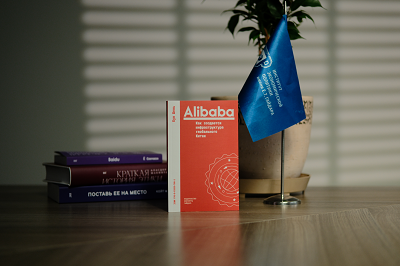
Maria Girich, Researcher of International Best Practices Analysis Department at the Gaidar Institute, wrote a review of a book by Hong Shen ”Alibaba. Infrastructuring Global China”, released by the Publishing House of the Gaidar Institute in 2026.
The book is devoted not so much to the history of a single corporation (Alibaba unites approximately 290 companies in various sectors, from IT to pharmaceuticals), but rather to an overview of a new model of economic organization, where digital platforms operate simultaneously as markets, infrastructure, and development institutions.
Alibaba is not just a marketplace or an IT company, it is rather a holistic digital infrastructure that has become a tool for globalization of an entire country, that is, China, as well as a mechanism for entering foreign markets while maintaining internal secrecy. This is why it is still unclear whether Alibaba is a Chinese or a foreign company. On the one hand, the digital sector actively attracted foreign investment, but on the other, access to the Chinese market for foreign companies remained severely restricted. Thus, is Alibaba really a Chinese company with global capital or a transnational entity with a Chinese core?
Several key ideas can be identified. First, platforms are becoming a new type of infrastructure. While previously railways and power grids formed the foundation, now it is data pools, cloud technologies, payment systems, and logistics (especially cross-border), which can also be controlled by large, dominant (but now digital) companies. Alibaba acts as a creator of such an infrastructure used by millions of consumers and companies. For example, Alibaba actively supported creation of data centers abroad, facilitating the sale of Chinese software to foreign companies. Thus, platforms like Alibaba effectively become natural monopolies. In China, this is reinforced by government policies aimed at supporting local companies in the digital sector and the country's digital sovereignty on the whole.
Secondly, it reveals the idea of China's dual digital strategy: on the one hand, the development of a "domestic internet," on the other, a drive for international digital expansion. Initially, the priority was the creation of a sovereign, closed digital infrastructure (the Great Firewall of China), but the development of platforms has enabled China to enter foreign markets.
At the same time, Alibaba initially focused on SMEs, the so-called "shrimps", stimulating their exports through B2B tools and foreign digital infrastructure, including data centers in the US, Singapore, and Hong Kong, which were created not so much to meet local demand as to facilitate the entry of Chinese suppliers and digital services. This differentiated Alibaba from American platforms, which historically focused on large businesses.
Despite attempts to encourage Chinese companies to enter foreign markets, Alibaba eventually realized that the domestic market was much larger and demand higher (more than a third of global e-commerce comes from China) compared to global markets. Therefore, Alibaba refocused on the domestic market, including building infrastructure in remote areas of China, while foreign revenues accounted for only 10% of its earnings.
Third, Alibaba's governance structure and investment-based growth model are attractive. Despite its significant foreign capital (investments from the US, Japan, Switzerland, and elsewhere), China has severely restricted foreign companies' access to the digital sector, driving them out. For example, in 2008, China introduced a rule that non-banking organizations (such as Alipay, also owned by Alibaba) must obtain a license when providing online payment services, however, only Chinese-owned entities could obtain such a license. This allowed Alibaba to drive out foreign providers from the market, such as PayPal which at that time belonged to the major marketplace eBay and with whom Alibaba was fighting for power. China's policy of protecting its domestic market (often in defiance of the WTO rules) and the lack of any real competitors to Alibaba allowed the platform to develop. Protectionism and the virtual lack of competition gave Alibaba the opportunity to aggressively expand into related sectors: pharmaceuticals, electronics, and media.
Restrictions for foreign companies in China resulted in development of the variable interest structure, i.e., joint ownership by foreign investors and Chinese partners with capital directed to wholly Chinese-owned companies. This prompts the author to ask whether Alibaba is truly a "Chinese" company? On the one hand, the company operates in China, enjoys government support, participates in government projects (for example, social credit rating), and Jack Ma is involved in legislative processes. On the other hand, there is active foreign capital participation, listing on foreign exchanges, and a commitment to global trade (for example, establishment of the World Trade Platform (eWTP)).
Fourth, the role of data in building digital infrastructure is crucial. The author highlights that over 70% of Alibaba's revenue comes from marketing. However, advertising, promotion, and data analytics are all based on large data stores. The author cites cases where data helped Alibaba to compete. For example, attempting to compete with JD (another major marketplace in China), the company used pools of consumer behavior data to open warehouses and distribution centers, allowing to better optimize routes, inventory, and delivery times.
Data also played a role in competition when developing payment services: Alibaba used behavioral and trading data of marketplace users in its battle for dominance with Tencent (the developer of WeChat), to develop Alipay and fintech services (they used this data to create credit scoring systems). Another example is Alibaba's acquisition of a pharmaceutical company that processed massive amounts of medical data.
Thus, it demonstrates that the data is the platform's key asset, which can be aggregated and monetized, allowing it to achieve a dominant position and drive competitors out of markets, especially if the data is exclusive, meaning it cannot be obtained elsewhere (for example, by purchasing or collecting similar data).
Thus, the book considers the social significance of digital giants like Alibaba, which create services not only for individuals and businesses but also for the state, and possess vast amounts of valuable data, enjoying state support. This drives these platforms to become providers of critical digital services for the population.