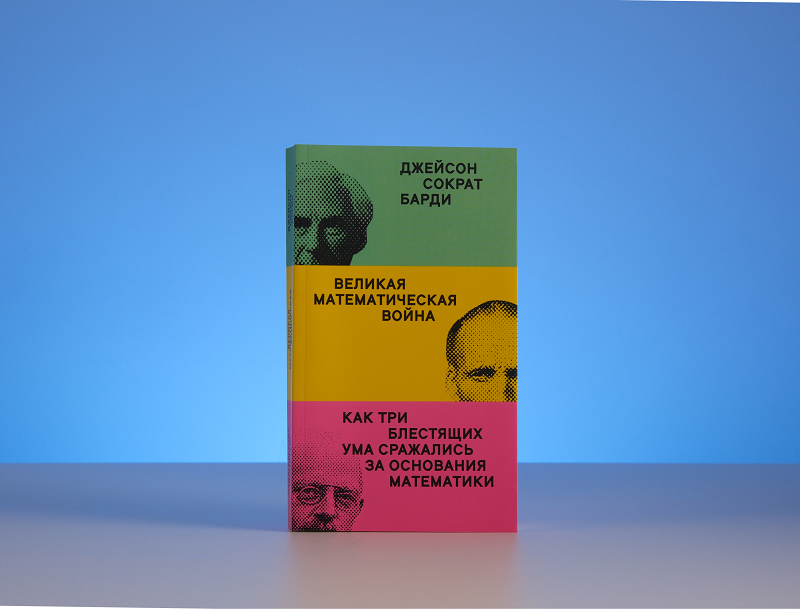
Leonid Irbekovich Urutskoyev, Doctor of Physical and Mathematical Sciences and professor at Abkhaz State University, presented a review of Jason Socrates Bardi’s book The Great Math War, published by Gaidar Institute Press in 2026. This is the story of how three outstanding mathematicians—Bertrand Russell, David Hilbert, and L. E. J. Brouwer—in a fierce intellectual and personal struggle proposed different ways to resolve the Crisis of the Foundations of Mathematics, thereby shaping the development of science for the entire 20th century.
As a work of popular science, Jason Socrates Bardi’s The Great Math War is written in a rather unusual style and reads like an intricate “culinary dish” composed of seemingly incompatible ingredients: mathematics, philosophy, history, and geopolitics. The foundation of the dish—or, figuratively speaking, the framework of the book—is undoubtedly mathematics. The main intrigue of the narrative centers on attempts to solve the most crucial problem in mathematics, which crystallized in the late 19th and early 20th centuries: Can the internal logical contradictions underlying the very foundations of mathematics be overcome? Can we equate mathematical and logical truths and derive mathematics from logic? Was the attempt to reduce set theory to logic successful? What is mathematical infinity, including the infinity of the natural number sequence? Here is a brief list of mathematical-philosophical problems that the main characters of the narrative grapple with: Bertrand Russell, David Hilbert, and Lötzen Brouwer. They adopt different approaches in their attempt to find a way out of the looming fundamental crisis in mathematics. Bertrand Russell proposed viewing mathematics as an extension of logic, David Hilbert believed that mathematics should be viewed as a “formal game with arbitrary rules, no different from chess,” while Lötzen Brouwer asserted that mathematics is entirely based on human intuition and that “it is not logic that lies at the foundation of mathematics, but mathematics that lies at the foundation of logic.” As can be seen, the approaches of these three outstanding mathematicians differ greatly: logical, formal, and intuitive.
There is no point in recounting the substance of the purely academic debate that unfolded at the beginning of the last century among the three main figures of the narrative. Jason Bardi has presented it quite objectively and professionally in his book. Of course, mathematicians may find flaws in the precision of the formulations of G. Cantor’s and K. Gödel’s theorems or in the rather loose presentation of E. Zermelo’s axiom of choice. But it must be remembered that this book is not a textbook on set theory. Surely not all future readers of this book have a background in mathematics.
For example, for physicists, mathematics is the language for describing physical laws and serves as a tool for discovering new physical regularities (such as group theory), which are then tested experimentally. It is used to create the coherence and elegance of physical theories, to perform numerical calculations, and for much more. It is impossible to imagine modern physics without mathematics. Without mathematics, physics would have remained natural philosophy. While paying due respect to the magnificent edifice of mathematics, physicists nevertheless demonstrate a rather utilitarian approach to mathematics: using what has already been done without delving into the intricacies of the mathematical “kitchen.” Just as we, when communicating in Russian, have little interest in the subtleties discussed within a narrow circle of Russian language specialists. As for the essence of the discussion described in the book, physicists, without any “pangs of conscience,” actively and fruitfully use all three approaches: logical, formal, and intuitive.
The intuitive approach is mainly used by experimentalists, since they are the ones who try to pry the truth out of Nature: how is it actually structured? They ask Nature questions using modern experimental equipment that is highly complex and, as a rule, expensive. And they receive answers. Here, it is very important to know how to avoid asking Nature the wrong questions; otherwise, the answers will be quite incomprehensible. As for theorists, the formal approach prevails among them. For them, mathematics is not just a language, but almost a religion. In modern physics, a phenomenon is considered understood if it can be described by some mathematical formalism. It is precisely this approach that prevailed in physics after the development of quantum mechanics. Although at the beginning of the last century it was believed that to understand the essence of a new physical phenomenon, one must devise an intuitively understandable physical model of the phenomenon.
There is no doubt that the use of the formal approach in physics has proved highly fruitful; one need only mention the prediction of the existence of antiparticles made by Paul Dirac based on the solution of an equation. But the flip side of the coin is that the “unrestrained formalization” of physics has led to many physical theories becoming overburdened with unnecessary “mathematical fat.” It should be remembered that mathematical formalism rarely leads to a new physical idea. Conversely, a fruitful intuitive physical idea will sooner or later find its mathematical formalism.
Both theorists and experimentalists try to use a logical approach in conversations with their institutions’ administration about salary increases. Physicists rely on “logical” signs they see in stores—price tags—arguing that these signs are in logical contradiction with their salaries. But physicist-administrators firmly adhere to the intuitionist positions of Lötzen Brouwer (there is no point in talking about what cannot be imagined) and respond with the words: "there is no money—but hang in there".
When reading Jason Bardi’s book, modern readers cannot help but be genuinely surprised by the public outcry that accompanied what was essentially a purely academic mathematical debate. Modern society is ready to discuss the extravagant outfit of the latest “pop diva,” the outcome of a hockey game, the design of a new smartphone, or even a spaceflight to the Moon, but certainly not a mathematical debate. Apparently, at the beginning of the 20th century, society was much more receptive to fundamental problems in the natural sciences. And this is not surprising, since the turn of the century was a time of fundamental discoveries: the theory of relativity, the birth of quantum mechanics and nuclear physics, and the rapid development of chemistry and biology. Suffice it to say that Konrad Röntgen’s scientific article was reprinted in many newspapers of the time.
Unlike other popular science books on mathematics, in D. Barbi’s book, mathematics is examined in the context of the everyday lives of these three outstanding mathematicians themselves—so to speak, beyond the confines of their profession. With all the life’s turmoil and everyday problems they had to solve against the backdrop of the global political upheavals that engulfed Europe at the turn of the century. Drawing on the works of the main characters’ biographers, the author has succeeded in vividly portraying their personalities, complete with their inherent human virtues and flaws. The portrait of Bertrand Russell—the idol of his parents—is drawn with particular care and sympathy. Bertrand Russell possessed the highest intellect and was such a versatile and brilliant personality that it is impossible to say where he achieved his most impressive results: in mathematics, philosophy, or as a public figure. The book describes Bertrand Russell’s personal life in considerable detail, and his love for Ottoline Morrell is portrayed in a particularly touching yet unvarnished manner. The portrait of Ottoline herself is drawn with great, meticulous detail, down to the smallest nuances. It could not be otherwise, for she was the great love of Russell’s life, which, generally speaking, did not prevent him from having other admirers. Much less space in the book is devoted to the personal lives of two other outstanding mathematicians: David Hilbert and Lötzen Brouwer.
A detailed description of the geopolitical international situation of that period—against which the purely scientific discussion among the book’s main characters unfolded—is an essential “ingredient of the whole dish.” Anticipating the description of the Sarajevo incident—the very one that served as the “casus belli” for World War I—Jason Bardi meticulously notes: “… on average, one head of state was assassinated annually over the preceding two decades. Four kings, three American presidents, one empress, two heirs to the throne, and God knows how many minor politicians and courtiers were killed—shot, stabbed, poisoned, blown up, thrown out of windows, or otherwise eliminated in the course of individual terrorist attacks.” So why was it specifically the assassination of Archduke Franz Ferdinand that led to the deaths of some 20 million people and the collapse of three empires? Clearly, the matter lies not at all in this abhorrent murder, but in something else.
Bardi characterizes the international political situation that had developed by July 1914 with the following passage: “... France is embittered, Germany is self-assured, Austria is suffering from paranoia, Serbia is frightened, Russia is humiliated, Belgium is in terror, Great Britain is outraged, and Europe is doomed. Austria is shelling Belgrade, Germany supports Austria, Russia supports Serbia, France supports Russia, Germany declares war on Belgium and France, Great Britain declares war on Germany, and all roads lead to mutual destruction. … no one yet knows what horror this war will bring, but they are rushing toward it.” “You don’t walk at the start of a marathon,” Bardi remarks caustically. At the same time, it is surprising that the war broke out at all, Barbi argues in the pages of his book. “International trade in 1914 was so important that economic considerations could easily have outweighed political ones. … After all, in the context of globalization, everyone loses, regardless of who wins.” But the war began, and the main participants in the “math war” found themselves on opposite sides of the global conflict, yet all remained faithful to mathematics.
Johnson Bardi writes: “The paradox of World War I is that it is seen as both inevitable and unnecessary.” But an even greater paradox is that, a little over 100 years later, Europe is racing full steam ahead toward World War III. And one can repeat all the same old talk about the benefits of international trade, cultural ties, and much more, but all signs point to the fact that war is approaching. If a hundred years ago it was said that “war is waged for the sake of Honor,” now the same thing is said, only about Democracy. Ah, this democracy—an invention of the ancient Greeks. But the following circumstance seems strange: it turns out that problems with democracy exist only in those countries where there is oil, gas, and other natural resources. In those countries where there are no resources—the presence or absence of democracy does not bother anyone. A strange pattern…
And if we set aside all the verbal fluff about democracy, justice, and so on, what is the essence of the current European crisis? What are its epistemological roots? In the early 2000s, it became clear that the demolition of the Berlin Wall separating West and East Germany led to Europe and the U.S. building an identical “wall,” but this time between Ukraine and Russia. Only now, it was not the German people but the Russian people who found themselves divided! Ultimately, this is precisely the price of the USSR’s defeat in the Cold War. Of course, the West does not trust Russia, but Russia also has historical experience (Napoleon, Hitler) that compels it to doubt the sincerity of the West’s intentions. It is perfectly obvious that Russia is not thrilled by the prospect of having NATO missiles 800 km from its capital. And this is precisely the crux of the conflict between Russia and Ukraine (read: Europe).
And paradoxical as it may seem, the same words are being spoken from the very same capitals as a century ago (though one more “generalized” capital has been added: Brussels): war will make the world a fairer, safer, and more democratic place. It’s as if 100 years haven’t passed—the illusions remain the same. The pre-war situation of 1914, which Jason Barbi described in his book, is almost entirely mirrored in 2026. And once again, no one is troubled by the human cost that humanity will have to pay if the conflict escalates into an all-out war. Truly, history teaches us absolutely nothing.
After reading the book, the reader is inevitably left wondering: who, in the end, won the “Great Math War”? The answer is obvious: “Queen Mathematics” won. But there are no losers in this war, since the “mathematical struggle of the three titans” contributed to the development of two new branches of mathematics: mathematical logic and the theory of algorithms. Nevertheless, one might ask: can we consider the foundation of mathematics—strengthened by Ernst Zermelo’s “well-ordering” theorem (the axiom of choice) and Kurt Gödel’s “incompleteness” theorems—to be in a perfect state now? But it seems that not all mathematicians agree that there is nothing to worry about.
In 1972, the renowned Soviet mathematician Pyotr Konstantinovich Rashevsky published a very interesting article in the journal Advances in Mathematical Sciences titled “On the Dogma of the Natural Series” (Vol. XXVII, No. 4, pp. 243–246, 1972). Rashevsky’s main idea, as expressed in this article, is as follows: “A mathematical theory of integers in which numbers, when they become very large, would acquire in a certain sense a ‘blurred form’ rather than being strictly defined terms of the natural series, as we imagine them, would be more in keeping with the spirit of physics.” Such an idea cannot fail to “warm the hearts” of physicists, since there is nothing infinite in Nature, and the idea expressed by Rashevsky allows for a “smooth” transition from the discrete to the continuous. Unfortunately, I do not know whether this idea was further developed in the works of other mathematicians, and I have cited this article solely to show that “infinity” continues to stir the minds of mathematicians.
Jason Bardi’s book is written in a rather unusual style: a blend of historical novel, popular science book, and journalistic reportage. The book is written for a general audience, is not overloaded with “mathematical pedantry,” and therefore reads easily, like a historical novel with a “light” math slant. Numerous vivid metaphors and comparisons, along with occasional “choppy prose,” are typical of a journalistic style. This may annoy the more “academic” readers, but in my opinion, it is precisely this aspect that gives the entire book a certain unique charm. The book includes an annotated bibliography and over 600 references to original works. The sheer volume of work the author has put in cannot fail to command respect. Of course, if one looks for them, one can find a few rough edges in Jason Bardi’s book, but, as is customary to write in an opponent’s review of a dissertation: “the noted shortcomings in no way detract from the work’s obvious merits.” Therefore, Jason Socrates Bardi’s *The Great Mathematical War* will undoubtedly find its audience among Russian readers.