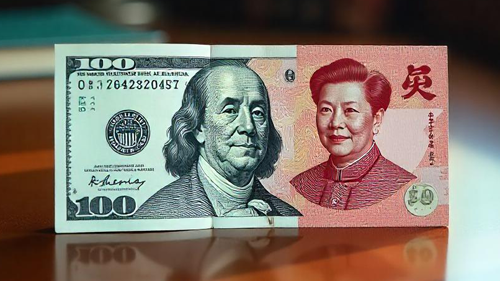
Amid growing geopolitical tensions on a global scale, trade wars, and the slowdown of globalization processes, the question of the future of the world’s reserve currencies is becoming particularly relevant. Evgeny Goryunov, Head of Monetary Policy Department at the Gaidar Institute, carried out analysis to find out how stable the dollar’s position is and whether the yuan will be able to compete with it.
According to IMF data, the share of the dollar in official reserves at the end of 2023 amounted to more than 58%, while the euro, the second most important currency, accounted for only 20% of international reserves. The trend of recent decades has been a gradual decline in the dollar’s share of international reserves. In 2000, the US dollar accounted for about 71% of reserves, thus the dollar’s share has decreased by 13 p.p. over 25 years. However, over the last 70 years the dollar’s share in reserves has fluctuated in a wide range (from 35 to 85%) and in the early 1990s it was lower than today.
According to the Bank for International Settlements, in the total turnover of the world foreign exchange market, the share of transactions in which the dollar was purchased by one of the parties has been quite stable since the early 1990s and ranged from 40 to 45%. Since the early 1990s,
Over the last 30 years, the share of countries that pursue a policy of active exchange rate management or have a fixed exchange rate has fluctuated between 60 and 70%. At the same time, half of the world GDP is produced in countries that explicitly or informally focus on the dollar as the nominal anchor of national monetary policy.
The above data indicate that the US dollar remains the world’s leading currency, and there are no signs of a significant reduction in its role in global finance and trade at the moment.
For any currency to compete for global leadership with the US dollar, it must, firstly, have a central bank with a reputation for responsible issuance that ensures the currency’s stability, and secondly, there must also be a system of financial institutions, deep and liquid markets, and an appropriate infrastructure. Such alternative currencies do not exist at the moment. The euro is unlikely to take the leading position due to low rates of economic growth (GDP growth for the period 2010–2023 in the euro zone amounted to 1.3% compared to 2.3% for the US and 2.9% for the global economy as a whole). Another structural weakness of the European currency is the absence of a single fiscal policy and a single sovereign borrower whose liabilities would act as an anchor reserve asset with high reliability and liquidity.
The yuan’s position has been strengthening in recent years. According to the IMF, its share in reserves increased from 1.1% in 2016 to 2.3% in 2023. The share of settlements in RMB through the SWIFT system is growing, reaching 4.7% by the beginning of 2024, which exceeds the share of the yen (4.2%) and approaches the share of the British pound (6.6%). However, when judged as a whole on various currency usage indicators, the RMB is still significantly behind not only the euro, but also the yen and the British pound. The yuan’s position currently corresponds to
Conclusions:
- The position of the US dollar at the moment looks stable and there are no tendencies to reduce its dominance.
- The yuan has been increasing its circulation in recent years and there is significant potential for its expansion, but its position still corresponds to the third echelon currency.