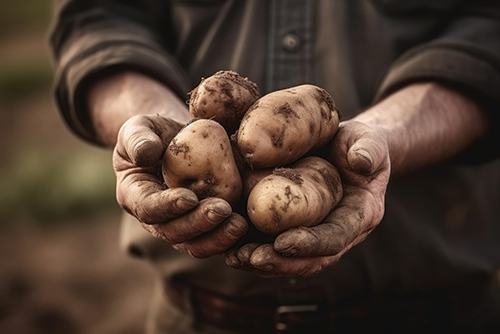
Denis Ternovskiy, an expert at the Economic Policy Foundation, commented on the record increase in potato prices in Russia to RTVI. He noted that one of the key reasons for the rise in prices is a decrease in the supply of potatoes on the market: according to Rosstat data, the potato harvest in Russia dropped by 12% in 2024.
Denis Ternovskiy noted that in fact the volume of potato production might be lower due to the decline in harvest in personal allotments, about which there is little annual available information. “Qualitative data emerges in the course of agricultural censuses, which are conducted every 10 years. And, as a rule, after the data are clarified, the volume of potato production by the population is retrospectively adjusted downwards,” the expert noted.
“It can be expected that the population will spend less time growing a relatively cheap product — their labor can be sold much more profitably. There is another side to the problem — when people stop producing, they do not stop consuming — they go to the store or market to buy potatoes, i.e. demand increases along with the reduction in supply. In addition, the need for storage facilities increases significantly — home cellars and storerooms must be replaced by industrial ones, and this is not a quick process, requiring significant capital investments,” said Denis Ternovskiy.
The expert also drew attention to the role of Belarus in the current situation. “Potato prices in Russia have become much higher than in Belarus, which led to an increase in supplies, often to the detriment of the local market. Since the level of price regulation in Belarus is higher, the market responds with available tools — if there is no opportunity to raise prices, there is a shortage of product. In Russia, this scenario has not yet been realized — additional demand is covered by increased imports without price restrictions,” said Dennis Ternovskiy.
The expert pointed out that in order to stabilize the situation on the market it is necessary not to have a low price, but its stability. “Now there is a risk that high prices this year will lead to future overproduction and the next price swings,” the expert concluded.