Alexey Zamnius, researcher at the Gaidar Institute's Mathematical Modeling of Economic Processes Department, plotted a graph of the dynamics of the human capital index per capita in China from 1950 to 2015, using data from Barro & Lee on the structure of the population's education (2013) and the Vollrath methodology (2020), which allows one to estimate the stock of human capital per capita taking into account not only years of education, but also their distribution by level of education.
The integrated indicator reflects the long-term effect of government strategies in education, health care and vocational training (Fig. 1).
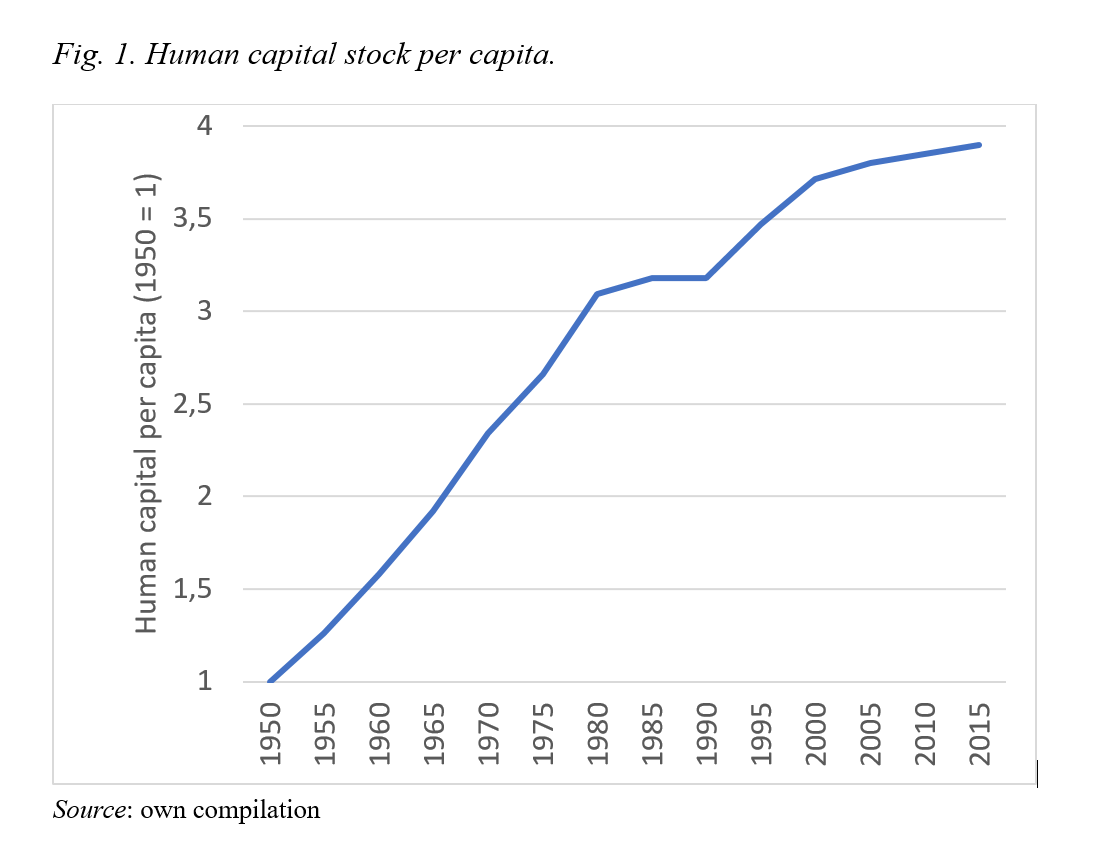
Three distinct stages can be explicitly seen in the index's trajectory from 1950 to 2015.
1950s–1970s: An extensive spurt. Over three decades, the index nearly tripled. The initial conditions were extremely difficult: the literacy rate was 15–20%, and the average life expectancy was around 35 years. The state launched massive literacy campaigns in villages and factories, created a network of public schools and introduced a "barefoot doctor" program for primary healthcare. At the same time, the Chinese Academy of Sciences was established, and thousands of students were sent to the USSR. This stage yielded rapid growth owing to extensive coverage of basic education and basic sanitary standards.
1980s–1990s: Slowdown and restructuring. Growth rates noticeably slowed down and stagnation began. This was not a failure, but a transition to qualitative reforms: university entrance exams were reinstated, the "recommendation" system was abolished, and the de-Sovietization of education began. However, the inertia of the previous system and the consequences of the Cultural Revolution required time. Growth continued, but no longer through mass enrollment, but through in-depth training, which objectively slowed the rate of growth.
1990–2015: Sustainable, high-quality growth. The dynamics are becoming stable and gradual. Drivers: the launch of Project 211 and Project 985 with multibillion-dollar funding, the creation of world-class universities and technology parks (Tsinghua Unigroup, Founder Group); internationalization – over 100,000 students studied abroad annually, programs for returning scholars (Hundred Talents, Changjiang Scholars); healthcare reform and the implementation of three health insurance systems (UEBMI, NCMS, URBMI), covering over 95% of the population by the 2010s. This improved health and extended working lives, which directly impacted the index.
Thus, the graph is a comprehensive snapshot of China's socioeconomic evolution: from mass mobilization to institutional reforms and a modern knowledge economy model. Today, China has approached the levels of developed countries, but further growth will depend on the balance between quantitative coverage and the innovative quality of education, especially in the context of technological change and an aging population.