An analysis of the dynamics of real wages by economic sector during 2021–2024 reveals key trends shaped by structural shifts triggered by the start of the special military operation. Alexey Zamnius, Researcher of the Mathematical Modeling of Economic Processes Department at the Gaidar Institute, used data from the Russian Longitudinal Monitoring Survey (RLMS-HSE) to identify a marked differentiation across industries in terms of wage growth rates.
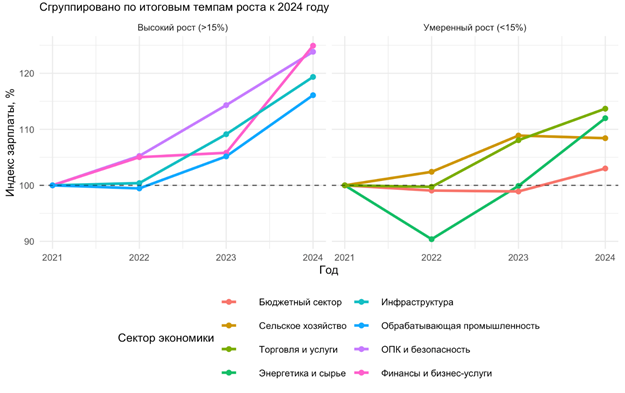
Fig. 1. Dynamics of real wages by sectors (2021 = 100%)
Source: compiled according to RLMS HSE
Growth leaders: Finance, the defense industry, and security
Two distinct groups of sectors stand out: those with high growth (over 15%) and those with moderate growth. The clear leaders were finance and business services (+25%), as well as the defense industry and security (+24%) (Figure 1). This result reflects a redistribution of economic resources in favor of these sectors: an increase in government defense procurement and growing demand for financial and business services amid sanctions pressure and economic restructuring.
Sectors with moderate growth: Infrastructure and manufacturing
Within the moderate-growth group, infrastructure (+19%) and manufacturing (+16%) were the most successful (Fig. 1). These sectors are demonstrating the effects of import substitution: increased construction activity, transportation, and the development of domestic production have created additional demand for labor and led to higher wages. Trade and services (+15%), as well as energy and raw materials (+13%), also showed positive trends, albeit with less pronounced growth.
Laggards: the public sector
At the opposite end of the spectrum was the public sector, which showed minimal growth—just +3–4% (Fig. 1). Amid high inflation and moderate indexation of nominal wages, the real incomes of workers in education, healthcare, science, culture, and social services are effectively stagnating. This indicates a persistent imbalance in wages between the public and private sectors, which only intensified during the special military operation.
Energy sector: V-Shaped trend
The energy sector demonstrated a V-shaped trend: a decline in 2022 was followed by a subsequent recovery (Fig. 1). However, the final growth rate (+13%) was more modest than in a number of other industries, which may be due to volatility in energy prices and adaptation to new export conditions.
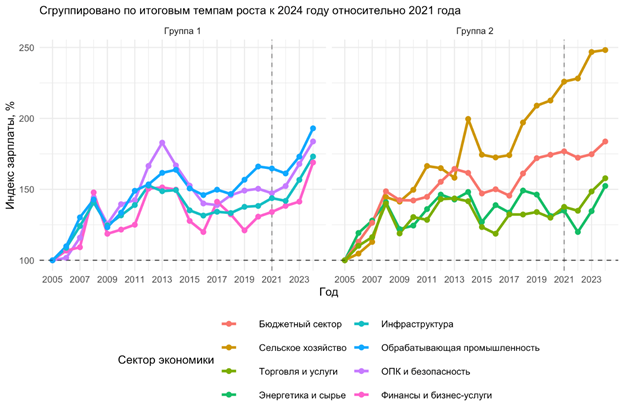
Fig. 2. Long-term dynamics of real wages by sectors (2005 = 100%)
Source: compiled according to RLMS HSE
Long-Term context
Over a longer time frame (since 2005), the picture looks different. Agriculture posted the highest growth during this period (+250%), while the energy and raw materials sectors posted the lowest (+155%) (Fig. 2). This suggests that current trends may not align with long-term ones, and that sectoral dynamics during the SVO period are largely determined by cyclical factors.
Inter-sectoral inequality is intensifying
The overall picture indicates a significant increase in inter-sectoral inequality in income distribution during the SVO period. The gap between fast-growing sectors (finance, defense industry) and the stagnating public sector poses risks to social stability and requires attention from government policy on wages. Public sector workers remain particularly vulnerable, as their real wages are failing to keep pace with inflation.
Thus, the sectoral analysis shows that the benefits of the current economic model are distributed extremely unevenly. To reduce inter-sectoral inequality, measures are needed to increase wages in the public sector.