Highest Exam: How the Gaokao Shapes China
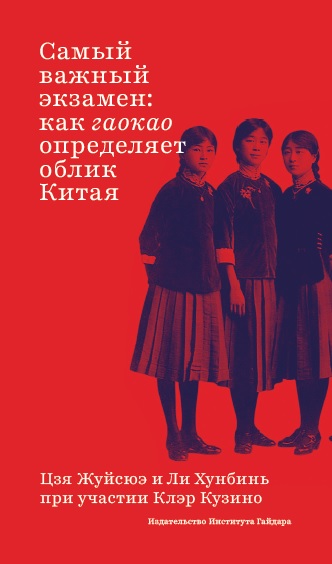
Jia Ruixue and Li Hongbin with Claire Cousineau
Translated from the English by S. Shchukina; edited by I. Chubarov. — Moscow: Gaidar Institute Press, 2026.
ISBN 978-5-93255-725-9
Each June, more than ten million Chinese students sit for the gaokao, China’s national college entrance exam, the local equivalent of the Unified State Exam. Just as in Russia, admission to universities in China is determined entirely by the results of this exam.
Given the importance of higher education, it’s no surprise that the entire nation is practically obsessed with the gaokao. Drawing on surveys, historical research, and political-economic analysis — as well as their personal experience of undergoing this grueling ordea — Jia Ruixue and Li Hongbin demonstrate that the Chinese education system functions as a centralized, hierarchical competition. The book explains why preparation for the gaokao begins as early as kindergarten, why the race for the highest score — which is costly in every respect — is entirely rational and justified, and how China’s examination system serves the interests of the Party and the state and, to a large extent, drives the country’s economic growth. The authors also draw attention to the long-term consequences of the gaokao for Chinese society. The meritocratic nature of the exam encourages citizens to focus on individual achievements and ignore issues related to structural inequality.